RCA Perspectives · Network RCA
Why Network RCA Needs More Than an LLM
It starts with a familiar alert:
“The BGP session is down.”
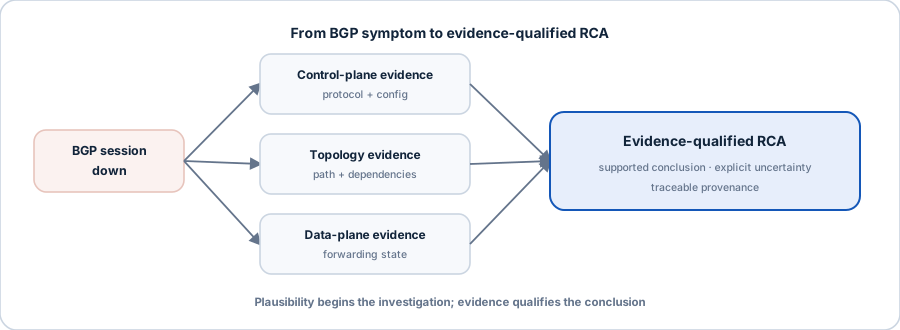
An engineer asks an LLM for the root cause. The answer sounds convincing: perhaps the neighbor configuration was removed, the remote device failed, or a filter blocked the session.
All are plausible. None is yet proven.
An LLM alone cannot bridge the gap: plausibility is not evidence.
One symptom, many possible networks
The same BGP alarm can arise from very different conditions:
- a configuration mismatch;
- a reachability problem;
- incorrect path or adjacency state;
- filtering somewhere along the path;
- an interface, device, or platform failure.
Some causes are visible in control-plane evidence. Others appear only in the data plane or in the relationship between observed state and the topology that should exist. Investigating that gap can require platform-specific operational expertise.
The alert text does not reveal which network state exists. Even a highly capable model cannot infer facts that the available observations do not distinguish.
RCA under production pressure
Production incidents rarely offer unlimited diagnostic time. The first objective is usually to restore service quickly. If the cause cannot be established in that window, the team still needs to capture enough relevant evidence for a reliable postmortem before recovery changes the failing state.
Doing this well often requires senior engineers. They decide which observations matter, which diagnostics are safe, what context to inspect, and when familiar protocol checks are no longer enough. The required evidence changes with the network, platform, and failure domain.
An RCA agent earns its place by helping acquire, connect, and preserve the right evidence while time is limited, not by guessing faster.
Where an LLM helps, and where it can fail
Language models are excellent at understanding an operator’s question, interpreting unfamiliar text, summarizing observations, and explaining a result. But unconstrained RCA introduces serious risks:
- Hallucination: inventing a fact, observation, or causal link.
- Topology blindness: reasoning without the actual path or dependencies.
- Premature closure: choosing a familiar explanation before collecting distinguishing evidence.
- Open-world mistakes: treating “not observed” as “does not exist.”
- Inconsistent reasoning: reaching different conclusions from equivalent evidence.
These risks are not solved simply by using a larger model. Network RCA requires the system to distinguish what is observed, what is supported, what is still unknown, and what kind of evidence could narrow the remaining possibilities.
Why structured reasoning matters
Structured reasoning represents the operational problem explicitly through topology, operational state, dependencies, and provenance. It can constrain conclusions to what the evidence supports, preserve uncertainty when observations are incomplete, and keep the path from source evidence to diagnosis available for review.
Structured reasoning gives the model a narrower, more useful role. It can interpret observations and communicate a conclusion inside an inspectable evidence process instead of generating the most plausible story from incomplete context.
Topology-aware without pretending the world is complete
A useful RCA system must be topology-aware: conclusions should reflect the incident-specific devices, paths, operational state, configuration intent, and service dependencies. A diagram alone is not enough.
But the entire live network cannot safely be treated as fully observed. Missing evidence must not automatically mean absence. A sounder approach is evidence-bounded reasoning:
- conclusions are limited to what the current evidence supports;
- unresolved possibilities remain explicit rather than quietly becoming false;
- when observations cannot distinguish competing explanations, the system asks for more evidence or escalates instead of inventing a cause.
That discipline matters especially when symptoms cross the control plane and data plane. An unexplained forwarding inconsistency may justify deeper diagnostics, but it does not by itself prove a particular component fault.
A division of labor
Language models and structured reasoning serve complementary roles:
- the language model provides a natural-language interface, flexible interpretation, and clear explanation;
- the structured reasoning layer maintains evidence-qualified state, preserves uncertainty, and keeps conclusions traceable;
- the operational evidence layer supplies the topology, state, dependencies, and provenance needed to distinguish plausible stories.
In network operations, a useful answer must be more than believable. It must be grounded in the network that is actually running.
Combining them enables fluent collaboration around evidence without treating fluency as a substitute for proof.