RCA Perspectives · Agentic Operations
Network RCA Is the Wedge for the Agentic Operations Platform
A network alert rarely points at its own cause.
The session-down alarm may originate in a configuration change several hops away. The apparent capacity problem may be a path-selection problem. The application timeout may begin in the underlay, surface in the overlay, and appear to the user as a service failure.
That distance between where a problem appears and where it begins is what makes network operations such a demanding proving ground for agentic AI. It is also why Causalis starts with Network RCA.
Causalis starts from a specific product thesis:
Network RCA is the wedge. The agentic operations control plane is the platform.
Start with a problem that demands evidence, cross-domain reasoning, and operational discipline. Prove that the system can help investigators reach better-supported conclusions. Then extend the same governed foundation across infrastructure, application, and security operations.
The real bottleneck is evidence
Networks already produce enormous amounts of data. The difficulty is turning it into a coherent explanation while an incident is still unfolding.
The relevant evidence may be distributed across routing state, interface counters, configuration history, topology, flow data, logs, tickets, and recent changes. Each source reveals a fragment. None necessarily contains the root cause by itself.
Network diagnosis is an inverse problem: many causes can produce the same symptom, and one cause can produce many symptoms. A useful RCA process has to distinguish among competing explanations, identify what evidence would separate them, and preserve uncertainty when the available observations are incomplete.
A conversational model can make this process easier to navigate. It can interpret unfamiliar output, summarize observations, and explain a conclusion. But fluency alone does not close the investigation. The system still needs to ground each important claim in operational evidence and show how that evidence changed the diagnosis.
A plausible answer becomes operationally useful only when its evidence is visible.
Why Network RCA is the right starting point
A strong product wedge exposes the larger problem a platform is built to solve. Network RCA does that unusually well.
The pain is frequent, not exceptional
The dramatic outage gets attention, but much of the operational burden is the daily investigative grind: intermittent reachability, unstable adjacencies, unexplained loss, configuration drift, and alerts that cannot be localized from a single dashboard. Reducing that burden creates value before a system is trusted to make production changes.
The evidence is naturally cross-domain
Network behavior crosses layers, devices, vendors, and operational systems. A useful investigator must connect rather than merely summarize. That makes RCA a strong test of whether an agentic system can work across existing tools without pretending that one source contains the whole truth.
The outcome can be reviewed
An RCA conclusion can be compared with the evidence, the engineer’s decision, and the observed outcome. This makes practical evaluation possible. Reviewers can ask whether the conclusion was supported, useful, and consistent with what happened next, instead of judging how convincing it sounded.
The stakes force the right architecture
Network changes can widen an outage or cut off the path used to recover from it. A system built for this environment has to separate investigation from execution, keep policy in the action path, and make autonomy conditional on risk and evidence. Those disciplines are valuable everywhere else in enterprise operations too.
A wedge is not the platform
A team can build an impressive network assistant as a collection of prompts and connectors. That may answer questions or automate a familiar diagnostic sequence. It does not yet create a durable operating model for agents.
The platform problem appears when the first useful agent becomes the fifth:
- How do agents work from a consistent evidence context without flattening source provenance?
- How are identities, permissions, approvals, and operational boundaries applied consistently?
- How does a specialist hand work to another specialist without losing the investigation state?
- How are outcomes evaluated as models, tools, and environments change?
- How does reviewed operational knowledge become useful to later investigations without turning stale guidance into false confidence?
Solving each question independently inside each agent creates another generation of operational silos. The Causalis thesis is that these concerns belong in a shared agentic control plane.
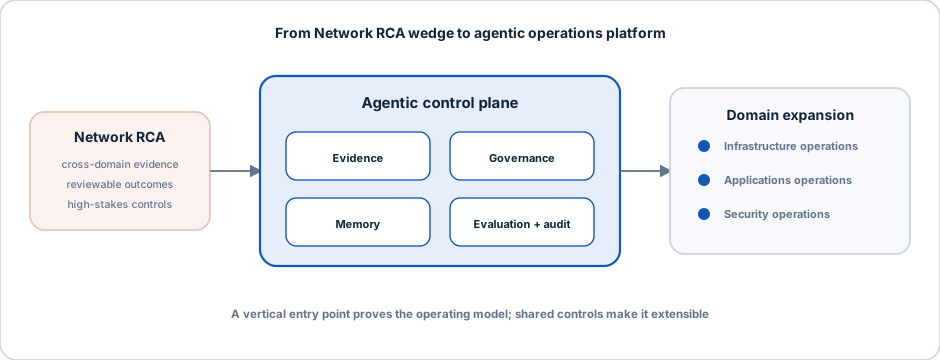
The control plane sits above the monitoring and operations tools a team already trusts. It coordinates how agents use evidence, invokes domain reasoning under explicit authority boundaries, requests operational permission, preserves context, and demonstrates what happened. The language model remains the collaboration layer; it does not become the source of topology, protocol truth, or causal proof.
The model is a component in that system. The operating discipline around the model is the platform.
How Causalis expands from the wedge
1. Land with evidence-grounded Network RCA
Begin with investigation and recommendation. Help an engineer connect the symptom to the relevant control-plane, topology, data-plane, and change evidence. Make unsupported possibilities visible as possibilities, not facts.
Investigation and recommendation deliver value while the human remains in control of production changes. They also test the hardest part of operational AI early: whether the system can gather enough distinguishing evidence to move from correlation toward a defensible causal explanation.
When the available observations still admit different network worlds, the correct result is an explicitly narrowed set, localization, or non-identifiability statement plus the next distinguishing evidence—not a single cause selected for narrative convenience.
2. Prove the control plane under real operational pressure
Network investigations exercise shared capabilities: evidence access, specialist coordination, authorization, auditability, memory, and evaluation. Network RCA therefore becomes more than a feature. It becomes the first demanding workload for the operating layer beneath the agents.
The proof comes from operations. Teams must be able to inspect why a conclusion was reached, understand what remained unknown, control what the system was permitted to do, and measure whether quality improved over time.
3. Expand the operating model across domains
Infrastructure, application, and security incidents differ in their tools and domain knowledge, but they share the same control problems. Evidence is fragmented. Actions carry risk. Context crosses team boundaries. Models and integrations change. Outcomes need to become learning signals.
Once those common concerns are handled as platform capabilities, new domain agents can focus on their specialty rather than rebuilding governance, memory, evaluation, and audit from scratch.
The result is a vertical entry point on a horizontal control plane.
Autonomy grows with evidence and evaluation
Autonomy varies by action and risk. Different actions deserve different levels of authority.
A system may investigate and explain broadly, prepare a proposed change under tighter constraints, and execute only a small class of well-understood actions within explicit boundaries. Teams may widen those boundaries deliberately only when evidence quality, scenario evaluation, policy, and observed operational outcomes justify it. A confident model response is not an authorization signal. When the proof state or context is insufficient, the system should ask for more evidence or escalate.
The need is clearest for agents that combine untrusted operational inputs, access to sensitive systems, and the ability to change state. Meta’s Agents Rule of Two reaches a similar practical conclusion: high-impact combinations need reliable supervision rather than prompt-level confidence alone.
Causalis treats governance as part of the architecture that makes capability usable.
The compounding advantage is operational learning
Many operational workflows effectively reset at the end of the incident. The dashboard clears, the ticket closes, and the reasoning that connected symptom to cause disappears into chat history or one engineer’s memory.
An agentic operations platform should make a reviewed investigation useful to the next one. That does not mean copying every trace into an embedding index. It means retaining the parts that have earned trust: the evidence that mattered, the conclusion it supported, the decision that followed, the observed outcome, and the conditions under which the lesson remains valid.
The reviewed learning loop works like this:
- an incident produces evidence and a proposed explanation;
- an operator decision and the observed outcome qualify that explanation;
- the reviewed result becomes advisory context for similar future work, not evidence that the current incident has the same cause;
- evaluation shows where that context helps and where it misleads.
The value is not that the system remembers everything. The value is that it can carry forward what the organization has learned without hiding provenance or uncertainty. This does not require live retraining or automatic rule mutation; those are separate, higher-risk capabilities with their own evaluation and promotion gates.
What buyers should demand from an agentic operations platform
The category will attract broad autonomy claims. A more useful evaluation starts with operational questions:
- Evidence: Can the system show which observations support each important conclusion?
- Uncertainty: Does it preserve unknowns, or turn missing evidence into confident prose?
- Authority: Are observed facts, deterministic conclusions, learned ranking, and language-model explanation kept visibly separate?
- Identifiability: Does the system say when the admitted evidence cannot distinguish cause or service impact?
- Control: Are investigation, recommendation, approval, and execution distinct operating states?
- Scope: Can authority be bounded by user, agent, environment, action, and risk?
- Learning: Can reviewed outcomes improve later work without silently spreading stale context?
- Evaluation: Are correctness, grounding, safety, latency, and cost measured separately?
- Inspectability: Can an engineer reconstruct what the system saw, decided, and did?
This emphasis on realistic, multidimensional evaluation is consistent with NetPress, which evaluates network agents against environmental feedback across correctness, safety, and latency rather than relying on static answer matching alone.
Those questions belong at control-plane level. The specific model matters, but it cannot answer them by itself.
The platform follows from the problem
Network RCA is where Causalis begins because it makes the central challenge impossible to avoid. The system must reason across fragmented evidence. It must distinguish plausibility from support. It must work with the tools already in place. And it must remain governed even when the pressure to automate is highest.
Solving that problem establishes the foundation for a new operating layer across enterprise operations: shared evidence, shared controls, shared learning, and domain agents that can become more capable without becoming less accountable.
Causalis begins with this bet:
Start where the symptom is farthest from the cause. Build the control plane that lets trustworthy agents expand from there.