
The Agentic Ops Series · Part 1 of 12
Why Agentic Ops: The Case for a Closed Operational Loop
The Agentic Ops Series · Part 1 of 12
Modern operations teams drown in signals. A single degraded service can fan out into thousands of alerts across half a dozen tools, and the engineer paged at 2 a.m. spends most of their time not fixing anything; they spend it correlating. Metrics live in one console, logs in another, traces in a third, the change that caused it all in a ticketing system nobody opened, and the actual remediation knowledge in a senior engineer's head.
The value of agentic operations does not come from a smarter model or a cleverer tool. It comes from closing the operational loop across sensing, evidence-qualified reasoning, decisions, action, reviewed learning, and explanation as one governed, continuously evaluated system.
We have spent fifteen years multiplying tools across observability, ITSM, and ITOM, yet in many environments root-cause analysis is still manual cross-silo correlation. MTTR is often dominated by investigation and triage, not by the fix. The fix may be a one-line config change; the hour before it is a human stitching context back together across systems that were never designed to talk. That stitching is exactly the work that has matured enough to delegate.
MTTR is often dominated by investigation and triage, not the fix.
Architecture Snapshot
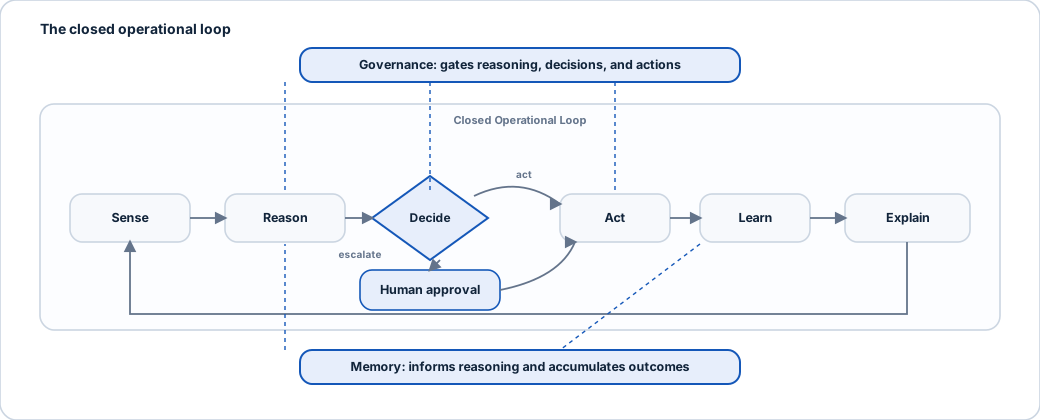
The six stages run as one cycle rather than a pipeline. A decision can route to a human before action, while Governance and Memory span the loop to gate activity and carry lessons into the next cycle.
What “Agentic Ops” Actually Means
Agentic operations coordinates models, domain reasoners, evidence services, policy, and tools to sense, investigate, decide, act, and learn under review. A language model can interpret requests, propose investigative steps, and explain results; it does not become the authority for operational facts or root-cause proof. The emphasis is on the governed evidence loop, not on a conversational surface.
The distinction matters because the term gets stretched in two unhelpful directions:
- It is not a chatbot. A chat window that answers questions about your infrastructure is a retrieval interface. It does not form hypotheses, pull evidence to test them, or carry state across an investigation.
- It is not static runbook automation. A scripted workflow executes a fixed decision tree someone wrote in advance. The moment reality deviates from the tree, it stalls. An agentic system can select and test new investigative steps, while typed evidence, domain semantics, and policy constrain what it may conclude or execute.
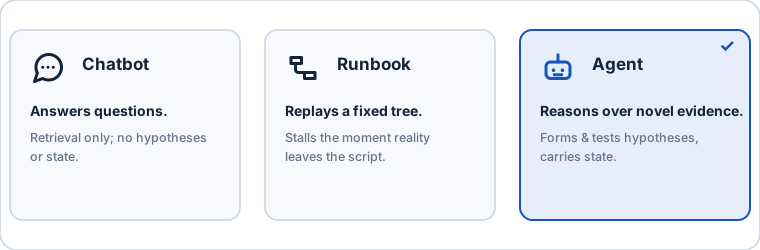
The distinction is operational, not semantic. An agent that can read an unfamiliar trace, connect it to a recent change, and propose the next evidence needed to test a hypothesis is doing work a script may not encode and a chatbot will not initiate. The trace and change still establish only what their provenance and scope support.
Why Now
Three things changed at roughly the same time.
First, language models became useful enough as planners, interpreters, and tool-using collaborators to build into operational workflows. ReAct formalized interleaved model reasoning and tool calls; Reflexion explored critique and revision. These patterns improve investigation, but they do not make model-generated conclusions self-validating.
Second, tool and data access got a standard. The Model Context Protocol gives agents a uniform way to reach systems and context without a bespoke integration per tool, which is what makes a fleet of connectors tractable rather than a maintenance sink.
Third, telemetry is abundant and increasingly structured. The raw material an agent needs to reason over has never been richer.
But abundance and capability do not add up to safety. Naive autonomy can be unsafe when an agent runs a destructive command and unreliable when it infers a root cause from thin evidence. This is why the disciplines in this series exist. Governance, memory, evaluation, and explainability are not features layered on top of a working agent. They are the conditions under which autonomy is allowed to operate at all.
Sense without Reason is another dashboard. Act without Governance is a liability. The loop compounds; the pieces do not.
The Closed Loop Is the Thesis
Every other post in this series is, in some form, about one stage of a single loop. Defined in one line each:
- Sense: ingest and normalize signals across silos into one typed, correlatable view of state.
- Reason: maintain and test competing hypotheses using domain semantics and scoped evidence, preserving alternatives and unknowns when the observations do not distinguish them.
- Decide: choose an action and route it through policy: allow, deny, or require a human.
- Act: execute the chosen action against real systems through validated, scoped tools.
- Learn: qualify reviewed outcomes before they can influence later incidents; learning is a governed lifecycle, not an automatic write from every run.
- Explain: make the evidence, hypothesis, decision, action, and outcome chain inspectable.
No stage delivers durable value in isolation. Sense without Reason is another dashboard. Reason without Decide is a suggestion engine. Act without Governance is a liability. Learn without Memory is a log. Explain is what makes any of it trustworthy enough to leave running. The loop compounds; the pieces do not.
Levels of Autonomy
“Autonomous” is a dial, not a switch. It helps to borrow the levels-of-automation framing from human-factors engineering and place agentic ops on a ladder:
- Assistant: answers questions and surfaces context on request. The human drives everything.
- Copilot: proactively investigates and proposes a diagnosis. The human evaluates and acts.
- Supervised autonomy: investigates, decides, and prepares actions, but high-risk steps wait at a human-in-the-loop gate before executing.
- Bounded autonomy: acts end to end within an explicitly constrained blast radius, escalating only when it leaves that boundary.
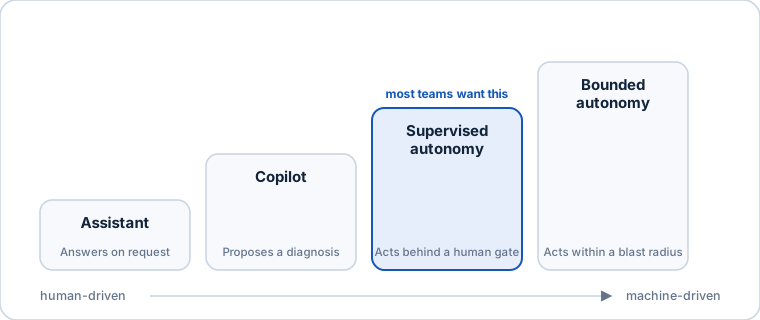
Most organizations, correctly, want supervised autonomy: full-speed investigation, human approval for anything that mutates production. The right design does not pick one level globally; it sets the level per action class, by risk, and makes that boundary a machine-enforced policy rather than a convention people are trusted to remember.
Defensible RCA Needs Connected Evidence
The reason siloed tooling cannot close the loop is structural, not a matter of integration effort. A defensible root-cause investigation often requires evidence from systems with fundamentally different semantics:
- MELT: metrics, events, logs, and traces, the observability substrate of what is happening.
- ITSM: tickets, incidents, and change records, the record of what we did and when.
- ITOM: topology and CMDB relationships, the map of how things depend on each other.
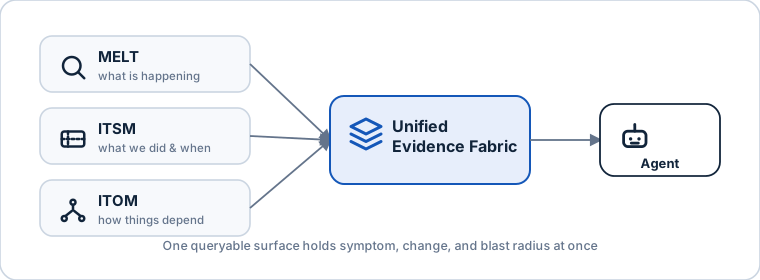
A plausible causal account often crosses these boundaries: a latency spike (metric) traces to a specific service (trace) whose error log (log) appeared minutes after a deployment (change record) on a node that an upstream dependency (topology) relies on. No single observability or ITSM product holds all of that. An agent that has to query four tools and reconcile their schemas in free-form text is doing the worst part of the human’s job. The evidence should therefore enter one typed, incident-specific context while retaining source provenance, observation time, scope, and completeness. A unified view improves investigation; it does not make an incomplete world closed or turn correlation into cause.
The Series Roadmap
The rest of the series examines the capabilities that make the loop operable: unified evidence, composable and coordinated agents, useful memory, governed action, model economics, security, evaluation, and explainability. Each part focuses on the principle and its trade-offs rather than prescribing a single implementation blueprint.
Foundations & Prior Art
The framing draws on established work:
- The discipline being automated: Site Reliability Engineering (Beyer et al., Google, 2016) named toil and error budgets; agentic ops is, at its core, an attempt to automate the toil SRE identified.
- The reasoning loop: ReAct (Yao et al., 2022) interleaves reasoning and tool use, and Reflexion (Shinn et al., 2023) adds self-critique and correction. Together, they form the loop that makes investigative agents viable rather than brittle.
- Standardized tool and data access: the Model Context Protocol (Anthropic, 2024), a uniform interface between agents and the systems they reason over.
- Observability: the MELT model (metrics, events, logs, traces) and the broader distributed-systems observability literature, which define the signals an agent senses over.
- Levels of automation: Parasuraman, Sheridan & Wickens (2000), A model for types and levels of human interaction with automation, the human-factors basis for the autonomy ladder above and for keeping a human at high-risk decisions.
What to Measure
If the loop is working, the numbers move:
- MTTR, and specifically time to a supported cause, defensible localization, or explicit non-identifiability
- toil percentage: share of on-call time spent on repetitive correlation rather than judgment
- repeat-incident rate: recurrences that share an identical, already-known root cause
- % of incidents auto-triaged or agent-assisted, separated by autonomy level
- on-call load: pages per engineer per rotation, and how many resolve without human investigation
Key takeaways
- The value of agentic ops comes from closing the loop across sensing, reasoning, decisions, action, learning, and explanation.
- MTTR is often dominated by cross-silo correlation and triage; that stitching is the work now mature enough to delegate.
- Autonomy is a dial set per action class by risk and enforced by policy. Most teams want supervised autonomy.
- Root-cause investigation needs MELT, ITSM, and ITOM connected in a provenance-preserving evidence context; unified access is not causal proof.
Next
Part 2 maps this loop onto a concrete five-layer platform architecture: data fabric, agent runtime, intelligence and memory, control plane, and enterprise layer.
Cover photo: Conny Schneider / Unsplash.